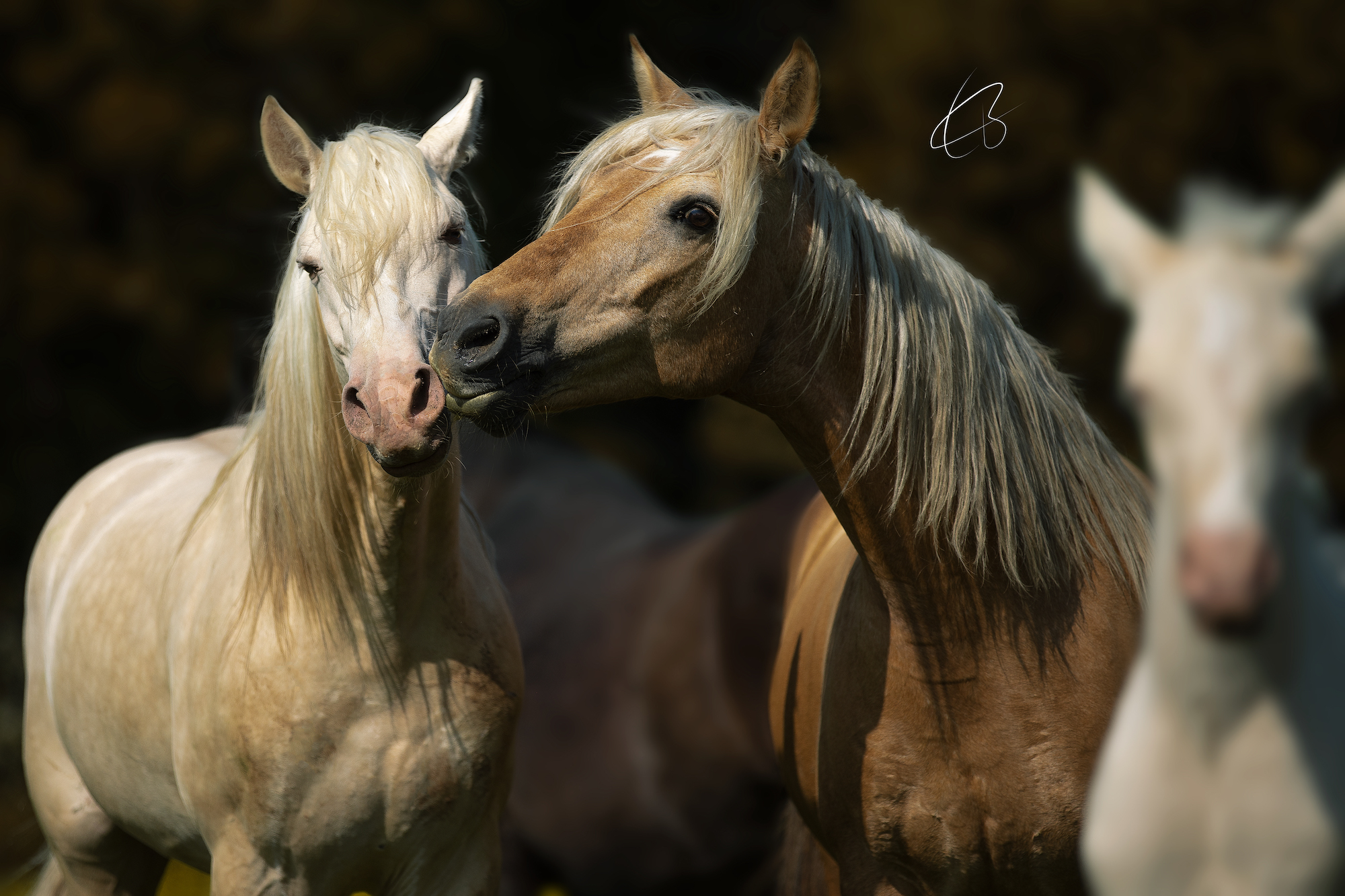
The Pure Spanish Horse
Origins, standard, coat colours and temperament
The guide from the Le Gan Eden stud farm
What is a Pure Spanish Horse?
The Pure Spanish Horse — Pura Raza Española in Spanish, PRE for short — is a Spanish horse breed whose identity rests on a strict studbook. A horse is not a Pure Spanish Horse because it looks the part: it is one because both its parents are entered in the breed studbook and because it is itself registered there.
This is an essential distinction, and the first source of confusion for anyone discovering the breed. You very often hear people talk about the “Andalusian horse”, after Andalusia where the breed took shape, or about the “Iberian horse”. These terms are telling, but they correspond to no official designation. An Iberian-type horse without papers is not a PRE, however closely it resembles the standard. Conversely, a PRE born in Normandy, in Belgium or in Germany remains a PRE as long as it is properly registered.
The breed studbook, the Libro Genealógico, is kept by the ANCCE, the Spanish national association of Pure Spanish Horse breeders, which has managed it since 2007 for every horse of the breed, whatever its country of birth. It is this single framework that guarantees that a buyer, wherever they are, knows exactly what they are buying.
A breed shaped by history
The Iberian Peninsula has been horse country since antiquity, and Greek and Roman authors already praised the handiness of Iberian mounts in battle: Plutarch described the horse of Hispania as beautiful, docile, proud and valiant. But it was in the 16th century that the breed took the form we know today, when Philip II had the best stallions and mares of the Guadalquivir provinces brought together in the Caballerizas Reales of Cordoba.
The Spanish horse then became the prestige mount of the European courts. Its ability to collect, to turn short and to work calmly made it the natural support of the academic riding being codified at the same period, and it is among the breeds that contributed to the making of the Lipizzaner and of several European riding horses.
Among the historic bloodlines, the one known as cartujana holds a place apart. It owes its name to the Carthusian monks of Jerez de la Frontera, who maintained a consistently selected breeding programme over several generations. It is recognised as a family within the breed, not as a separate breed.
The breed has been through difficult periods — wars, epizootics, collapsing numbers — before the studbook and the work of the breeders' associations gave it a solid footing again. The PRE is today the most widespread horse in Spain, bred in more than sixty countries, France among them.
The breed standard
The PRE is a medium-sized horse, harmonious and compact, in which the whole matters more than any detail taken on its own.
The head
A straight to slightly convex profile, a broad forehead, large expressive almond eyes, well-defined jowls. It is a head that expresses calm rather than nervousness.
The neck
Long, arched, well set out of the withers and generously furnished. It is the visual signature of the breed, the one that gives the PRE its unmistakable head carriage.
The back and croup
A short, solid back, a well-attached loin, a rounded and sloping croup. A compact whole, which explains the PRE's natural aptitude for collection.
The mane and tail
The standard describes a long, silky mane and a full tail, often wavy. On studs, clipping the mane remains a widespread practice, particularly with youngstock and mares: it shows off the horse's outline without taking anything away from the standard, which describes the finished horse.
Size
Most often between 1.55 m and 1.70 m at the withers, with a minimum height required for breeding qualification. A medium-sized horse, whose compact build gives an impression of power.
The paces
Elevated, cadenced, with a great deal of hind-leg engagement. The standard looks for elevation and regularity more than for scope.
Temperament, its true signature
While the PRE first appeals through its looks, it is its mental qualities that explain its lasting success. It is a horse that seeks contact with people, that learns quickly and that keeps its calm in situations where other breeds tense up.
This docility should not be confused with apathy. The PRE is a sensitive horse, sometimes very sensitive, which picks up finely on its rider's intentions. That is a quality when the work is fair and progressive; it becomes a difficulty with a hard hand or contradictory demands.
That is also what explains why it is found just as much in dressage competition as with leisure riders. The same horse can carry an experienced rider in the morning and go for a quiet hack in the afternoon — provided its education has been built with that in mind. That is precisely the breeder's work, and the point of our breeding philosophy.
The coat colours of the Pure Spanish Horse
Grey is by far the most common colour in the breed, so much so that it has become its reference image. Remember that a grey horse is born another colour and lightens with age: a foal born black may become light grey as an adult. Then come bay and black, both well represented, followed by chestnut.
Beyond these base colours, we enter the field of dilutions: genes that lighten the horse's colour without replacing it. The first is the Cream gene (Cream). In single dose it gives palomino on a chestnut base and buckskin (buckskin) on a bay base; in double dose it produces the very pale, blue-eyed coats that are cremello and perlino. Another dilution gene, the Pearl gene (Pearl), works in a similar way and combines with Cream.
The Dun gene is a dilution gene distinct from the Cream gene, and far rarer in the Pure Spanish Horse. It lightens the base coat while keeping what are known as primitive markings — a dorsal stripe along the back, zebra bars on the legs, sometimes shoulder markings. On a bay base it gives bay dun; on a black base, grullo (grullo). Combined with the Cream gene, it produces dunskin (dunskin) and dunalino (dunalino).
Work on the Dun gene in the Pure Spanish Horse is our stud's speciality. It calls for particular rigour: systematic genetic testing, a detailed knowledge of genotypes, and above all a refusal to sacrifice conformation or temperament to the pursuit of a colour alone. A rare coat on a mediocre horse is of no interest.
In which disciplines?
The PRE is a versatile horse, whose natural qualities draw it towards collected work.
Dressage
Its ease in collection and its attitude to training make it a sought-after dressage partner, from club level to international classes.
Doma vaquera
The traditional Spanish equestrian discipline, born of cattle work, for which the breed was shaped over centuries.
Haute école
Airs above the ground and academic work: the PRE is one of the breeds historically associated with classical riding.
Driving
Its calm and its presence make it a well-regarded driving horse, in single harness as well as in pairs.
Shows
Presence, abundant mane and tail, an aptitude for work in hand: the PRE is a show horse par excellence.
Leisure
Its balanced temperament and its willingness also make it an excellent leisure and trail horse for the amateur rider.
Papers, registration and grading
Entry in the studbook goes through the identification of the foal, parentage verification by DNA test and registration with the ANCCE, which then issues the horse's Carta de Origen — the document certifying that it belongs to the breed. In France, registration with the SIRE and the identification document issued by the IFCE are added to this, and are compulsory for any equine whatever its studbook.
Beyond registration, the breed has put in place a breeding qualification. A horse presented and accepted at this examination is said to be APTO, APTA for a mare: it has passed an assessment of its conformity to the standard and of the quality of its paces. This qualification is a useful marker for a buyer, even without breeding plans: it means an outside, competent eye has looked the horse over.
Finally there are the genetic tests, which make it possible to know a horse's genotype — for the colour genes in particular — and to screen for certain disorders. With us, they are part of every horse's file, and are provided without needing to be asked for.
In France, the AECE is the association of Pure Spanish Horse breeders; Le Gan Eden is a member. Registration with the ANCCE, on the other hand, concerns every PRE by the very fact of the studbook: it is not a distinction.
The Pure Spanish Horse at Le Gan Eden
Our stud is based in Sées, in the Orne, in Lower Normandy. Our Pure Spanish horses live there in semi-freedom, with selection work focused on conformation, temperament and rare coat colours — the Dun gene in particular.
We have been showing our horses in conformation classes in France and Belgium since 2022, an outside demand that confirms — or corrects — our breeding choices.
Frequently asked questions
It is the same horse, but “Pure Spanish Horse” (PRE, or Pura Raza Española) is the official name, the one used by the studbook. “Andalusian” is a common usage, inherited from the region where the breed took shape, but it has no official standing. A horse is only a PRE if it is entered in the breed studbook and has its papers.
Grey is by far the most common, to the point of becoming the stock image of the breed. Then come bay and black, followed by chestnut. Dilute coats are much rarer: palomino and buckskin, produced by the Cream gene, and above all the coats carrying the Dun gene — bay dun, grullo, dunskin — which are exceptional in the Pure Spanish Horse.
It is a horse that has passed the breeding qualification examination, which assesses conformity to the conformation standard and the quality of the paces. It is a useful marker even for a buyer with no breeding plans: it means an outside, competent eye has looked the horse over.
The PRE is known for its docility, its generosity in work and its ability to stay connected to its rider. It is a sensitive horse, which responds very well to fair riding but copes badly with roughness. This combination of sensitivity and calm is what makes it accessible to riders of widely differing levels.
A well-bred and properly backed PRE can certainly suit a less experienced rider, provided it is chosen for its temperament and not only for its conformation. Its sensitivity calls for consistency: a young horse and a novice rider are rarely a good match, whatever the breed.
Prices vary enormously with age, bloodlines, qualification, level of training and coat colour. An unbacked foal and a qualified stallion at the end of its development are nowhere near the same bracket. The safest approach is to define what you want to do with the horse first, then discuss it directly with the breeder.
Dun is a dilution gene, distinct from the Cream gene, which lightens the base coat while leaving primitive markings: a dorsal stripe along the back, zebra bars on the legs, sometimes shoulder markings. It is very rare in the Pure Spanish Horse. It produces bay dun and grullo, and, combined with the Cream gene, dunskin and dunalino.
The horse must have its Carta de Origen, the document issued by the ANCCE certifying that it is entered in the breed studbook. In France this is joined by registration with the SIRE, the identification document issued by the IFCE and an up-to-date health record. Always ask to see these documents before any purchase.
A question about the breed?
We are happy to answer questions about the Pure Spanish Horse, whether you have a purchase or a stud service in mind, or simply want to get to know the breed better.
Get in touch